Subscribe to this blog's posts


 Posts
All Comments
Posts
All Comments
Showing posts with label education. Show all posts
Showing posts with label education. Show all posts
Saturday, March 26, 2011
South Korea tops international tests
Sounds to me like some South Korean families are a bit over the top in their devotion to their children’s academic success. That’s not what I’m hoping for in River’s education. But I do expect more than just above average for a nation with the resources the United States has at its disposal. I thought these commonalities among top scoring countries, offered by the vice president for education at the Asia Society, are worthy of thought: *An emphasis on teacher quality - Hiring teachers from the top of their class, and training them well *An emphasis on equity -- Making sure that all schools have access to quality teachers *Longer school days and/or longer school years -- By the time they are ready for college some of these students have logged an extra year in the classroom (And we’re are talking about public schools, not private tutoring here.) *Greater coordination of academic standards and higher standards for all students (In the US, it's traditionally been every locality and state for himself). Results can be seen here.

Friday, January 28, 2011
Connect a million minds
A friend shared this video with me. I do wonder how the kids were selected and how representative they are of their countries. However, I also acknowledge the sobering statistics of where the U.S. ranks in terms of math and science achievement among youth. So I was glad to
hear that a movement has begun to bring attention to this issue.
My husband is in the math and science realm. I’m not. So I expected that he would be the one pushing math and science, while I exposed our children to culture, nature, languages, social sciences and adventures. I believe Mark will be a very good model and tutor in math and science subjects. He will be better positioned to answer questions, to explain how things work, to show the use of math and science in the workplace. But to my surprise, I’ve turned into the
stronger advocate of an education rich in math and science.
Perhaps it’s the fact that the best option we have available is an option where the instruction is in Chinese. That is accompanied by concerns about an ability to participate in the education, as well as possibly recognizing that our language and our country no longer sets the standard in this realm. I see the ability to navigate math and science in another language and among people of other cultures as only a positive, so I find the prospect even more attractive.
Granted, I probably won’t be of much assistance in River’s scientific or math education. The experiments they were running in the 3-year-old preschool class already included concepts I wasn’t familiar with. Did you know that if you put a white carnation in colored water, the petals would turn colors? I didn’t. Or that if you put a green bean seed in a dish with water and cotton it will do better than the green bean in a dish with just water?
Looking back on my math and science education, I think it was too little, too late. From junior high and high school, the courses were OK. But I recall almost no scientific exposure from elementary school and the math in my elementary school was way too easy for me. I took
home the workbooks in second grade and did the whole curriculum in a week or two. By the time I was able to skip a grade level in math, I was already in junior high, already spending my time passing notes in class, and was used to being bored. I wasn’t paying attention and had
lost interest in the subject.
Yes, in 10th grade my math teacher brought in a female engineer to talk to us about how she used math on the job. That was very eye opening and I appreciate the teacher’s initiative in exposing us to that. I wouldn’t have had any exposure otherwise. But it was too late by then. I was already slacking off in math, I already found it boring, and it was most definitely not cool in my school.
What if I’d been encouraged from the first days of elementary school, or from preschool, to explore the world around me? What if people had excited me and inspired me with the possibility of understanding how the world works, just at the time when a mind is full of questions and optimism? What if I’d been given the structure and the freedom to make hypotheses, test things out, and generate conclusions? What if I’d been in an environment where students and teachers were enthusiastic about learning and didn’t degrade achievement? I think I would have entered the core courses in junior high and high school with a greater sense of purpose, with greater enthusiasm, and with greater confidence.
I made it through college level calculus. But even then, I wasn’t fully paying attention. I regret to this day that I don’t have a stronger math background. Lacking the math makes it hard to advance in other fields, including medicine, science, engineering, economics and statistics.
I don’t care whether or not my children choose a scientific career. But I don’t want them to eliminate scientific careers because they weren’t sufficiently prepared. I want them to take in the principles and the concepts from an early age. I want them to have equal exposure to different realms – math and science, language, social sciences, music, art and spirituality – and to allow them to carry along further in whatever realms excite them the most. I want them to
have a better start than I did, and to not look back with any regrets.
I also know that this is not something I can teach them, that I need them to have access to quality math and science teachers. And beyond my own children, I’d like for all youth in our country to have the opportunity to compete for some of the best jobs on an equal basis
with kids from other countries. That is what makes me care about the low current standards and about making sure my children have access to quality math and science educations from an early age. I’m glad that more people are paying attention to this issue.
hear that a movement has begun to bring attention to this issue.
My husband is in the math and science realm. I’m not. So I expected that he would be the one pushing math and science, while I exposed our children to culture, nature, languages, social sciences and adventures. I believe Mark will be a very good model and tutor in math and science subjects. He will be better positioned to answer questions, to explain how things work, to show the use of math and science in the workplace. But to my surprise, I’ve turned into the
stronger advocate of an education rich in math and science.
Perhaps it’s the fact that the best option we have available is an option where the instruction is in Chinese. That is accompanied by concerns about an ability to participate in the education, as well as possibly recognizing that our language and our country no longer sets the standard in this realm. I see the ability to navigate math and science in another language and among people of other cultures as only a positive, so I find the prospect even more attractive.
Granted, I probably won’t be of much assistance in River’s scientific or math education. The experiments they were running in the 3-year-old preschool class already included concepts I wasn’t familiar with. Did you know that if you put a white carnation in colored water, the petals would turn colors? I didn’t. Or that if you put a green bean seed in a dish with water and cotton it will do better than the green bean in a dish with just water?
Looking back on my math and science education, I think it was too little, too late. From junior high and high school, the courses were OK. But I recall almost no scientific exposure from elementary school and the math in my elementary school was way too easy for me. I took
home the workbooks in second grade and did the whole curriculum in a week or two. By the time I was able to skip a grade level in math, I was already in junior high, already spending my time passing notes in class, and was used to being bored. I wasn’t paying attention and had
lost interest in the subject.
Yes, in 10th grade my math teacher brought in a female engineer to talk to us about how she used math on the job. That was very eye opening and I appreciate the teacher’s initiative in exposing us to that. I wouldn’t have had any exposure otherwise. But it was too late by then. I was already slacking off in math, I already found it boring, and it was most definitely not cool in my school.
What if I’d been encouraged from the first days of elementary school, or from preschool, to explore the world around me? What if people had excited me and inspired me with the possibility of understanding how the world works, just at the time when a mind is full of questions and optimism? What if I’d been given the structure and the freedom to make hypotheses, test things out, and generate conclusions? What if I’d been in an environment where students and teachers were enthusiastic about learning and didn’t degrade achievement? I think I would have entered the core courses in junior high and high school with a greater sense of purpose, with greater enthusiasm, and with greater confidence.
I made it through college level calculus. But even then, I wasn’t fully paying attention. I regret to this day that I don’t have a stronger math background. Lacking the math makes it hard to advance in other fields, including medicine, science, engineering, economics and statistics.
I don’t care whether or not my children choose a scientific career. But I don’t want them to eliminate scientific careers because they weren’t sufficiently prepared. I want them to take in the principles and the concepts from an early age. I want them to have equal exposure to different realms – math and science, language, social sciences, music, art and spirituality – and to allow them to carry along further in whatever realms excite them the most. I want them to
have a better start than I did, and to not look back with any regrets.
I also know that this is not something I can teach them, that I need them to have access to quality math and science teachers. And beyond my own children, I’d like for all youth in our country to have the opportunity to compete for some of the best jobs on an equal basis
with kids from other countries. That is what makes me care about the low current standards and about making sure my children have access to quality math and science educations from an early age. I’m glad that more people are paying attention to this issue.
Friday, November 12, 2010
Even good schools in the U.S. may not be so good compared to world standards
An important article in the Atlantic this month, one I passed along to
my husband as I try to advocate putting our son into an international baccalaureate (IB)-based program. He says our local public schools are good, which is true. They are good by U.S. standards. But they aren’t so great, especially in math, science and foreign languages, by world standards.
An intriguing excerpt reads:
“How would our states do if we looked just at the white kids performing at high levels—kids who are not, generally speaking, subject to language barriers or racial discrimination? Or if we looked just at kids with at least one college-educated parent?
As it turned out, even these relatively privileged students do not compete favorably with average students in other well-off countries. On a percentage basis, New York state has fewer high performers among white kids than Poland has among kids overall. In Illinois, the percentage of kids with a college-educated parent who are highly
skilled at math is lower than the percentage of such kids among all students in Iceland, France, Estonia, and Sweden.
Parents in Palo Alto will always insist that their kids are the exception, of course. And researchers cannot compare small cities and towns around the globe—not yet, anyway. But Hanushek thinks the study significantly undercuts the diversity excuse. “People will find it quite shocking,” he says, “that even our most-advantaged students are not all that competitive.”
One recourse would be to adopt IB or programs of similar quality standards in the local public schools. But according to the article, only Massachusetts has yet done this with any real effect, and even that state still has a way to go.
my husband as I try to advocate putting our son into an international baccalaureate (IB)-based program. He says our local public schools are good, which is true. They are good by U.S. standards. But they aren’t so great, especially in math, science and foreign languages, by world standards.
An intriguing excerpt reads:
“How would our states do if we looked just at the white kids performing at high levels—kids who are not, generally speaking, subject to language barriers or racial discrimination? Or if we looked just at kids with at least one college-educated parent?
As it turned out, even these relatively privileged students do not compete favorably with average students in other well-off countries. On a percentage basis, New York state has fewer high performers among white kids than Poland has among kids overall. In Illinois, the percentage of kids with a college-educated parent who are highly
skilled at math is lower than the percentage of such kids among all students in Iceland, France, Estonia, and Sweden.
Parents in Palo Alto will always insist that their kids are the exception, of course. And researchers cannot compare small cities and towns around the globe—not yet, anyway. But Hanushek thinks the study significantly undercuts the diversity excuse. “People will find it quite shocking,” he says, “that even our most-advantaged students are not all that competitive.”
One recourse would be to adopt IB or programs of similar quality standards in the local public schools. But according to the article, only Massachusetts has yet done this with any real effect, and even that state still has a way to go.
Friday, July 23, 2010
Learning moral values
Interesting op-ed in the NY Times today on anti-bullying efforts.
This highlights some of the tension I’m feeling about putting River into a classroom. Part of me wants him to integrate, to learn how to deal with people, to make his own way. But another part of me thinks kids are mean. I was sometimes mean and I definitely suffered from the meanness of others.
This highlights some of the tension I’m feeling about putting River into a classroom. Part of me wants him to integrate, to learn how to deal with people, to make his own way. But another part of me thinks kids are mean. I was sometimes mean and I definitely suffered from the meanness of others.
This is not purely child’s territory. There are plenty of uncomfortable, dangerous and morally ambiguous situations to navigate as an adult. But does going through this as a child teach kids how to handle it better as adults? I’m not so sure. I also think there is more meanness off the radar screen among kids. 4.5 instances per hour on the playground? How many of those are witnessed and addressed by an adult? Probably very few.
A friend of mine told me about how difficult the transition was for her from a Catholic grade school, where children were expected to be kind to each other, to a public school, where teachers did little moral enforcement outside of breaking up fist fights.
We aren’t religious, so attending a religious school is not on our radar screen. One of the main reasons I want to enroll River in the Unitarian religious education system though is to have some education and role models in his life on how to respect and treat other people, how and why it’s important to think about others and the role he plays in the larger world. Mark is not excited about this idea, as he’s suspicious of any organized religious group, regardless of how inclusive it might be. But I think it’s important for River to see both adults and children who embody the morals I want to teach him. I don’t think that hoping for a few in his public school class is sufficient nor do I feel confident that the children of good parents always behave in an ethical/moral manner around their peers.
Outside of attending a religious school, how do you expect your child to learn morals? Do you plan to teach him/her to be one of the few who intervenes when witnesses bullying? If so, how?
Saturday, May 29, 2010
Libros!
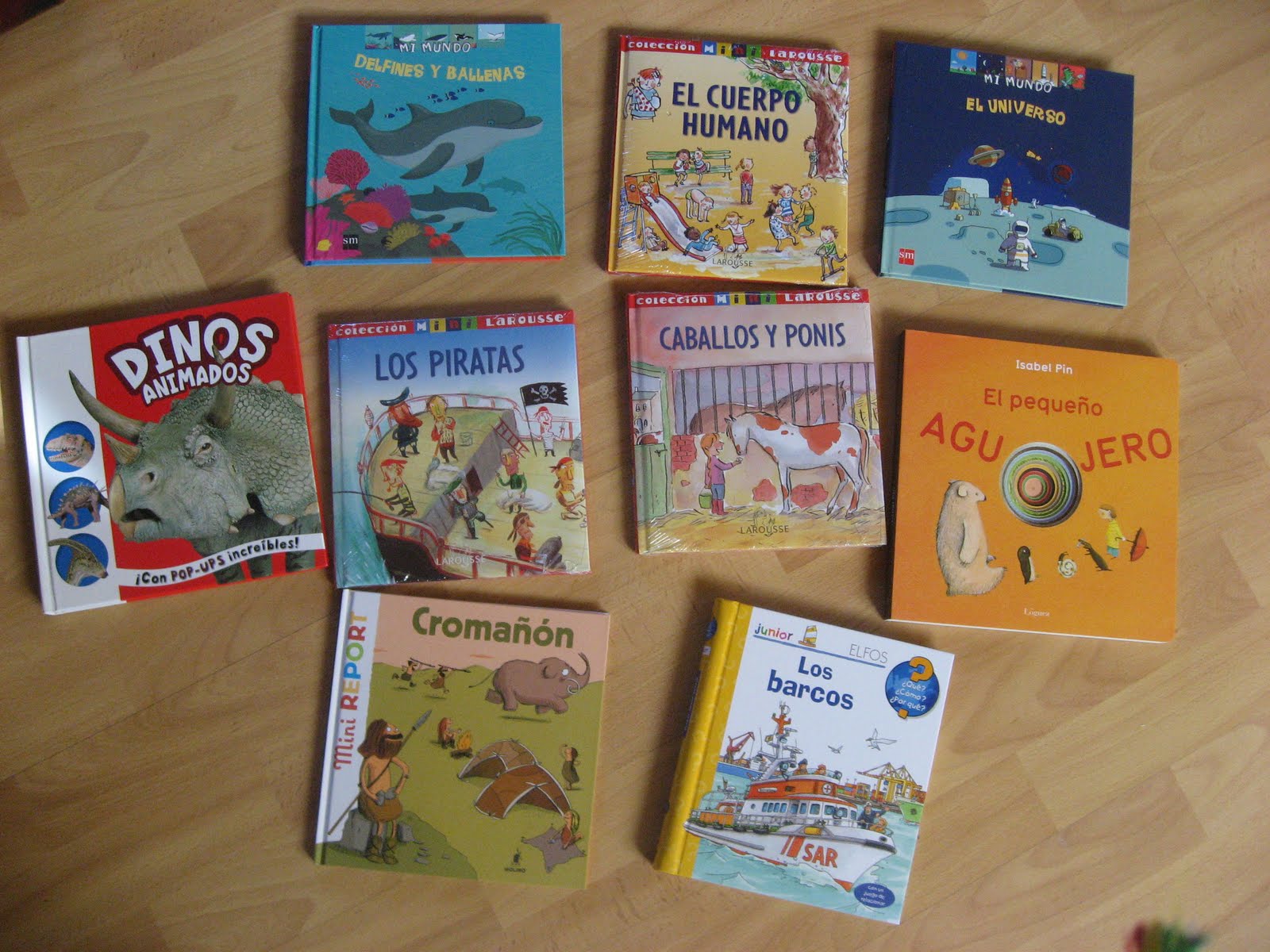

I’ve been waiting ages to get to Spain and to buy River some quality books in Spanish. The more I waited, the better sense I had of what kind of books he needed. My biggest priority was on non-fiction – books on science, pirates, castles, the universe, how things work, bugs, emotions. I got books on all those topics and more.
I got a book about a cricket by Eric Carle that ends with the sound of a cricket. I got a book about using tools that comes with several plastic tools. I got a book with 500 questions, including one River already asks about – What is the difference between a mountain and a hill? I got a book of short bedtime stories. I got a book on the origins of things. I got a huge encyclopedia of insects and bugs. I got a book about simians, with chapters on gorillas, bonobos and others. I got a book about the arrival of a new sibling, which includes a drawing of the mother in the hospital after giving birth, breastfeeding the new baby. The upper part of her breast and part of her nipple is showing.
I am SO thrilled with the books. I didn’t even look at the prices. I had waited so long, I wouldn’t have another chance for years. This wasn’t the time to be cheap. I studied the shelves and pulled off whatever I thought could be of use. The cashier looked at me in disbelief when I brought the huge stack to the register. I asked her not to tell me the price and I didn’t look as she was ringing it up.
I couldn’t help seeing it through upon signing the credit card bill. And Mark couldn’t help exclaiming at my spending over 300 euro. Thank goodness the exchange rate has moved in our favor in recent weeks.
“I hope you don’t complain when I buy River a personal computer,” Mark said
Of course it feels extravagant to spend over $400 within a half hour. That is far outside the normal for us. We have a budget of $100/month to spend on River, aside from food, childcare and education savings. I told Mark it would be several months of River’s allowance. I’ve bought him virtually no new clothes, very few new toys, and a few new books. We try to get everything possible secondhand. But I have not been able to find quality non-fiction books in Spanish secondhand. So I just had to accept the expenditure and let it go.
The fact that we have another on the way means that the books will be used to educate and entertain at least two. I can always sell them online when we are done, or donate them to the library, which would probably appreciate the addition to the Spanish language collection.
In the meantime, I’m so excited to share this new knowledge with River, and to learn the Spanish vocabulary words associated with these new subjects. I know he’ll be excited and will appreciate them. I look forward to many hours spent together reading and enjoying them. I’m already planning the next trip in a few years, to buy another set of age-appropriate books. In the meantime, our friends, seeing how very serious I was about building River’s Spanish language library, said they could save us the airfare and buy and ship books for us. Great.
Friday, May 28, 2010
It takes a village


I’ve been in Spain less than four hours and already I can see a place that puts “it takes a village into practice.” Our friends live in an apartment complex filled with small tykes. When I asked how it was possible to have so many toddlers in one building, they said it was due to the economic crisis. “There is nothing else to do,” Jose said. Or, as his mother theorized, perhaps it’s due to the storks that are prevalent in this area. One of these massive birds flew by as we sat at a table outside of a bar.
The complex has a locked outdoor patio, with a basketball court, swings and toys. “You can just let your kids run in here. Nothing can happen since it’s enclosed and there are always so many people we know here,” said Lucia. Giant roses – pink, yellow, red and fragrant – grew from small garden patches amidst the toys. “If someone needs to go and do something, someone else will watch their child.” It’s such a simple way to help the neighbors get to know each other, to interact, to help each other out, yet it’s not something I’ve seen in the United States.
From there, we went to a bar that was literally 10 feet from the front door of the building. Both adults and children congregated there. The kids could run around and play, the adults socialized and drank, everyone enjoyed themselves.
Our hosts quickly assembled a family group. Jose, his parents and his two brothers all live within a couple of buildings of each other. The three generations see each other all the time.
In the fall, 2.5 year old Jose Jr. will start preschool. It’s five days a week, located a five-minute walk from home, and can be as long as 8-3. My friend Lucia thinks it will be possible for her to find work that will allow her to pick him up by 3. The cost - $0. Public preschools are free, and education is mandatory from the age of 4.
I told them that the program we’d like to enroll River in next year costs $9,000 for four days a week, and that that is in the mid-range where we live. The cheapest programs are around $3,000, the most expensive can exceed $30,000. “$9,000 is about what we have budgeted for our child’s entire education,” Jose said.
Of course I like having a choice of programs, but I’m still mentally trying to come to terms with that price tag, and to financially prepare for it. I also think it’s wrong that some children have access to quality programs, and others don’t. I’d rather pay a bit more in taxes and allow all children the same opportunity.
Community, family, connection, support for parents and for early education for all – those are all values that I cherish. When I see them practiced elsewhere, it makes me sad that some people in my country think making each individual struggle, and the children to pay the price, is necessarily great. They may mock what they call “socialism.” But a little care for all people, and structures that support inter-reliance go a long way in terms of creating happy, secure and protected children – and adults.
Friday, May 21, 2010
tenets of unschooling
I’m not into unschooling, but I am into helping children develop their curiosities and passions, and promoting learning and exploration. So I liked this list on Marvelous Kiddo.
My favorite time spent with River is when I can take him along on things that interest me (bike rides, road trips) and help him to find things that interest him (turtles, wolves, crayon factories). I hope I can continue this when he does move on to school and life becomes more busy with routines and activities.
My favorite time spent with River is when I can take him along on things that interest me (bike rides, road trips) and help him to find things that interest him (turtles, wolves, crayon factories). I hope I can continue this when he does move on to school and life becomes more busy with routines and activities.
Saturday, December 20, 2008
Women Looking out for the Future
I’ve read quite a bit of academic research that concludes putting money into the hands of women is a good thing for children. This has been found to be the case in places as diverse as South Africa and the United States. The theory goes that men are more selfish – more likely to spend money on cigarettes, alcohol and other personal entertainment, while women are more likely to spend on clothing and education for their children, or in the U.S. on “treats” for their kids.
I didn’t really expect this to be the case in our family. Mark is a kind and very generous person. Though I’ve been changing in the past few years, I tend to be a penny pincher. Mark is much more willing to buy a $5-20 toy for River, when I’d rather pick up the same or a similar item used.
However, when we discussed the annual bonus Mark earned this year (he’s in an industry that hasn’t taken advantage of consumers and they are still getting their bonuses), we found ourselves in the more stereotypical gender roles. Mark’s preference was to split the income, so we could each do what we wanted with it.
“What am I going to do with that money?” I asked. There was nothing I wanted for myself that cost that much. Mark suggested travel, but the thoughts of travel I have in the near future are either family or work related.
I wanted to use $2,000 of the bonus to fund a Coverdell savings IRA for River. We already have a 529, but I think it would be good to do the Coverdell. The main difference is that the Coverdell can be used for elementary and secondary school expenses. It can also be used for a computer for River’s studies. So we might as well put the money away now and let it grow tax-free to help cover those expenses when they come up.
I wanted to use another portion to put into my Roth IRA. And then I’ve been suggesting we start one of those childcare savings accounts, where money used for childcare expenses is not taxed. And of course, there is the down payment for a house we’ve been saving up, and which has shrunk a bit since River’s arrival.
So here we were, the male wanting personal expenses for fun, the female wanting long-term investments in education, childcare and retirement. I’m not sure we’ve reached an agreement yet, but I think we’re heading towards making the investments and me showing some “understanding” when Mark wants a big-ticket item, like the cable, smart phone or computer he has been mentioning frequently lately.
I didn’t really expect this to be the case in our family. Mark is a kind and very generous person. Though I’ve been changing in the past few years, I tend to be a penny pincher. Mark is much more willing to buy a $5-20 toy for River, when I’d rather pick up the same or a similar item used.
However, when we discussed the annual bonus Mark earned this year (he’s in an industry that hasn’t taken advantage of consumers and they are still getting their bonuses), we found ourselves in the more stereotypical gender roles. Mark’s preference was to split the income, so we could each do what we wanted with it.
“What am I going to do with that money?” I asked. There was nothing I wanted for myself that cost that much. Mark suggested travel, but the thoughts of travel I have in the near future are either family or work related.
I wanted to use $2,000 of the bonus to fund a Coverdell savings IRA for River. We already have a 529, but I think it would be good to do the Coverdell. The main difference is that the Coverdell can be used for elementary and secondary school expenses. It can also be used for a computer for River’s studies. So we might as well put the money away now and let it grow tax-free to help cover those expenses when they come up.
I wanted to use another portion to put into my Roth IRA. And then I’ve been suggesting we start one of those childcare savings accounts, where money used for childcare expenses is not taxed. And of course, there is the down payment for a house we’ve been saving up, and which has shrunk a bit since River’s arrival.
So here we were, the male wanting personal expenses for fun, the female wanting long-term investments in education, childcare and retirement. I’m not sure we’ve reached an agreement yet, but I think we’re heading towards making the investments and me showing some “understanding” when Mark wants a big-ticket item, like the cable, smart phone or computer he has been mentioning frequently lately.
Subscribe to:
Posts (Atom)